Payload
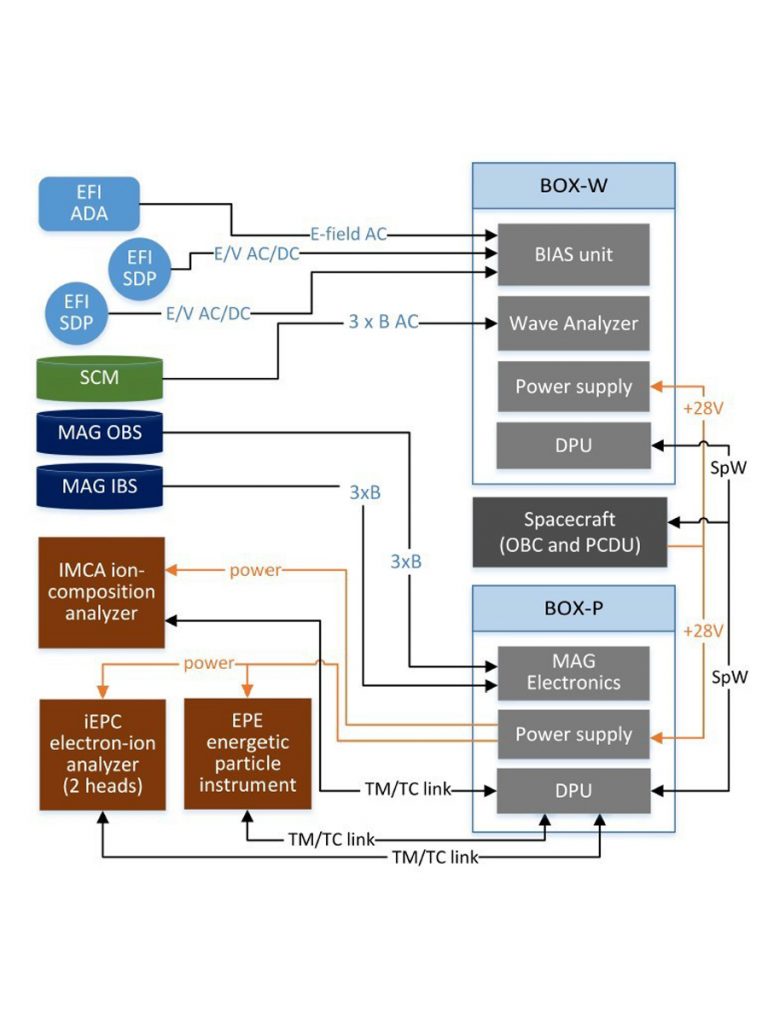
Plasma Observatory is a suite of 7 spacecraft that carry a payload complement of 9 science instruments (including two electronics boxes), able to provide a complete characterization of electromagnetic fields and plasma particles at ion and fluid scales for the variety of plasma conditions encountered in the key science regions around the Earth.
Electromagnetic measurements are provided by:
- the high-precision Fluxgate Magnetometer (MAG) that will measure the magnetic fields with DC measurements up to 128 Hz, complemented by
- a Search Coil Magnetometer (SCM) covering AC magnetic fluctuations from 1 Hz to 8 kHz.
- the EFI-SDP spherical double-probe sensor that will measure the electric fields and spacecraft potential, providing DC to 100 kHz coverage, together with
- the EFI-ADA axial dipole antenna, extending sensitivity to electric fluctuations between 10 Hz and 100 kHz.
Waveform and spectral products from SCM and EFI-SDP and EFI-ADA are processed by the BOX-W wave electronics unit.
Particle measurements are provided by:
- the iEPC ion–electron analyser, delivering three-dimensional distribution functions of ions and electrons at 250 ms cadence,
- the IMCA ion mass composition analyser, resolving H+, He++, and O+ distributions at 2 s cadence, and
- the EPE energetic particle detector, measuring energetic electrons and ions from 20 to 600 keV.
Processing of particle instruments data and MAG is performed by the BOX-P electronics unit.
The 2 central processing units provide the interface between instruments and spacecraft systems, enabling coordinated multi-scale measurements across the payload. The payload is identical on all 7 spacecraft with the exception of IMCA, which is only present on 4 spacecraft forming the outer tetrahedron.