
WAVES Instrument Suite (EFI, SCM and Box-W)
WAVES Suite
The WAVES suite comprises the Electric Field Instrument (EFI) and the Search Coil Magnetometer (SCM), together with their associated front-end and control electronics required to ensure optimal sensor performance. The suite provides full control of the sensors, performs signal conditioning and acquisition, and transfers the processed data to the spacecraft’s main computer. The signal-acquisition electronics and supporting subsystems are integrated in the BOX-W, which contains four dedicated printed circuit boards housing the analog, digital, and control functionalities of the WAVES suite.
The BOX-W
The BOX-W includes an analog circuit board (BIAS) implementing the front end for electric field measurements, a wave analyzer board (WAB) responsible for digitization and spectral processing of both electric and magnetic field fluctuations as well as a common data processing unit (DPU) and power supply. The DPU flight software handles all the data processing, reduction and compression of wave data without the need to offload any processing tasks to the platform computer. The flight software transmits to the spacecraft efficiently packed scientific data in the form of electromagnetic field time series, power spectra and cross-spectral matrices.
BOX-W is developed by a consortium led by IRF in Uppsala, Sweden with contributions from CBK, Warsaw, Poland, IAP, Prague, Czechia, LPC2E, Orleans, France and IWF, Graz, Austria.
SCM – Search Coil Magnetometer
The SCM design consists of a tri-axial set of magnetic sensors with its associated preamplifier. The sensors are based on a combination of a core with a high magnetic permeability and two windings. A flux-feedback is applied via the secondary winding to produce a flat frequency response and the phase stability which is needed to determine the wave polarization and to perform cross-correlation between satellites. The SCM preamplifier is connected to the BOX-W within the Waves instrument suite on each SSC, which digitizes the three analog waveforms delivered by SCM.
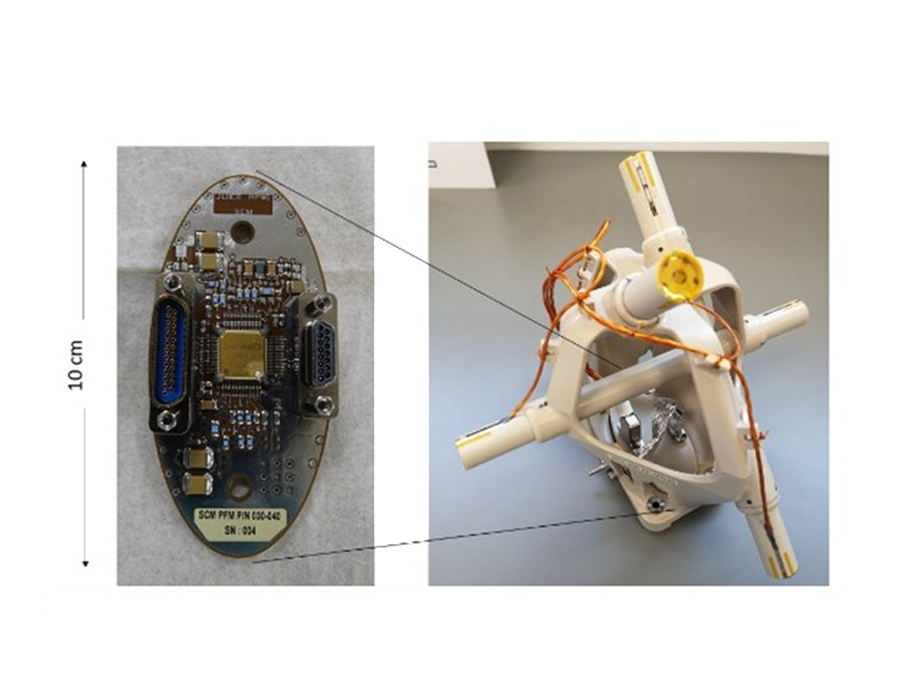
Heritage SCM sensor from JUICE RPWI with its preamplifier (including ASIC) inserted at the bottom of the tri-axis structure. The PO SCM design will be very close to the JUICE instrument.
SCM performance, driven mainly by the instrument noise, permits to resolve magnetic field oscillations covering a frequency range: 1 Hz to 8 kHz and a sensitivity of : [10^-3, 3.6 *10^-6, 10^-8, 2*10^-9, 2*10^-9] nT^2/Hz @ [1,10, 10^2, 10^3, 8*10^3].
SCM is jointly developed by LPP, Paris and LPC2E, Orleans, France, and its design is based on the most recent sensor developed for the ESA/JUICE mission.
EFI-SDP – Electrical field axial dipole antenna
Each of the two EFI-SDP electric field sensors is a spherical probe mounted at the end of the rigid boom, supported by a stub-and-root structure. This configuration, with correct biasing, allows the measurement of electric fields from very low frequencies up to hundreds of kilohertz. The signal is routed via a harness from the probe to the front-end electronics on the BIAS board in BOX-W.
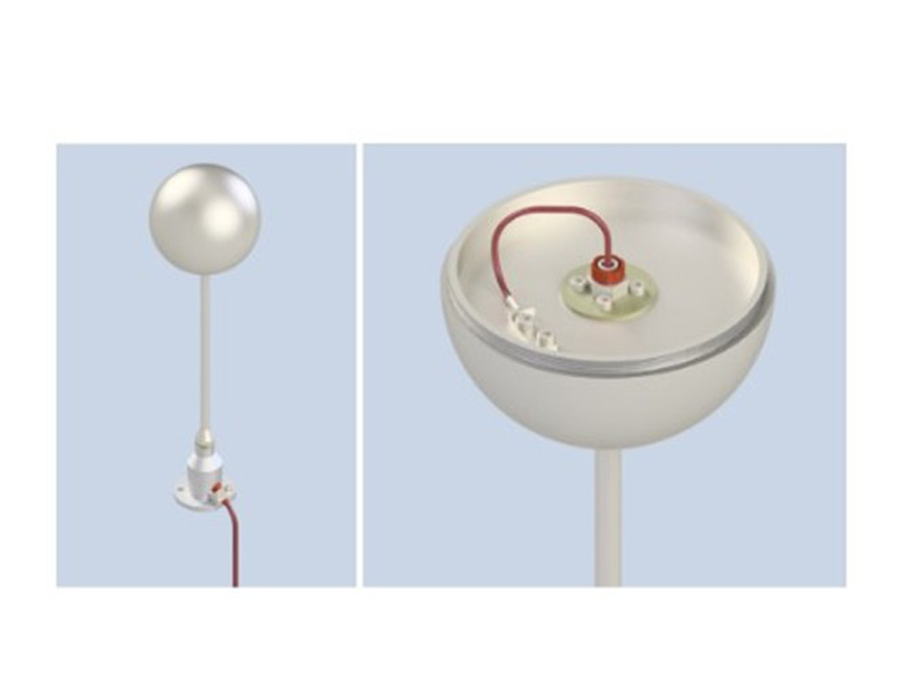
The sensor probe EFI-SDP and its supporting stub and root, as well as details of the electrical connection of the probe.
The sphere is composed of aluminum/titanium and copper, with the stub and root additionally using Vespel. The sphere will be coated with DAG213 black paint.
EFI-SDP is designed and manufactured by IRF, Sweden, based on RPC-LAP onboard the ROSETTA mission.
EFI-ADA – Electrical field spherical double probes
The Axial Dipole Antenna (EFI-ADA) sensor is a one-dimensional dipole-type electrical antenna to provide AC electric field measurements in a frequency range from 10Hz up to 100kHz. The tubular boom design offers an excellent mass to length ratio combined with a low noise, thanks to the sufficiently large boom diameter.
The antenna unit is mounted near the tip of one of the spacecraft rigid booms at a distance of about 2 meters from the S/C body and the antenna arms (dipole) are positioned parallel to the spin axis when deployed. Both antenna arms deploy simultaneously in opposite directions creating a 4 m tip-to-tip dipole.
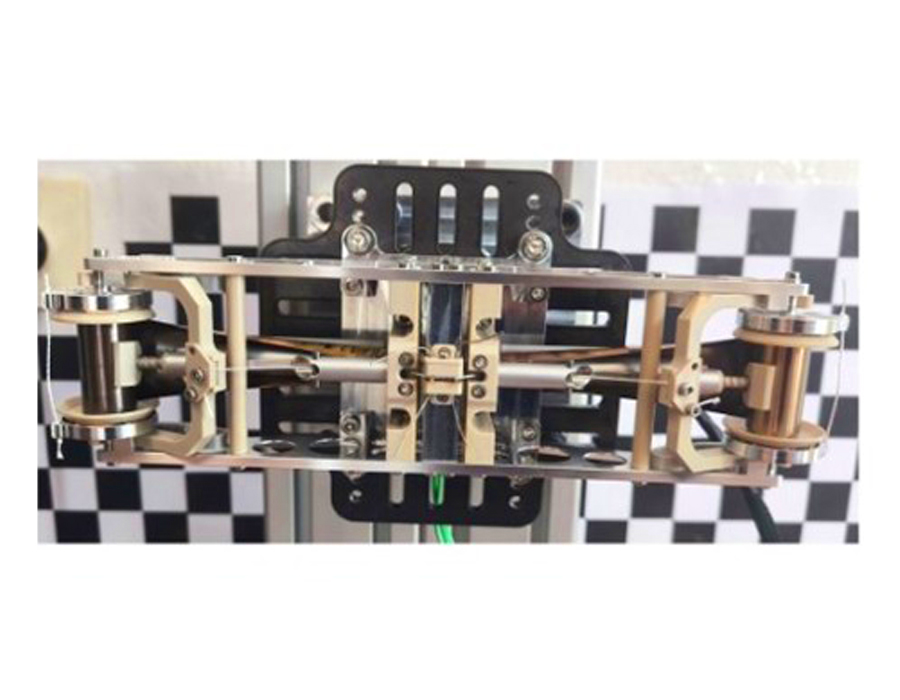
EFI-ADA design in its stowed prototype image.
Unlike in JUICE and most previous designs, there is no preamplifier in the sensor, making it extremely robust to radiation and temperature variations. All front end electronics are located in BOX-W.