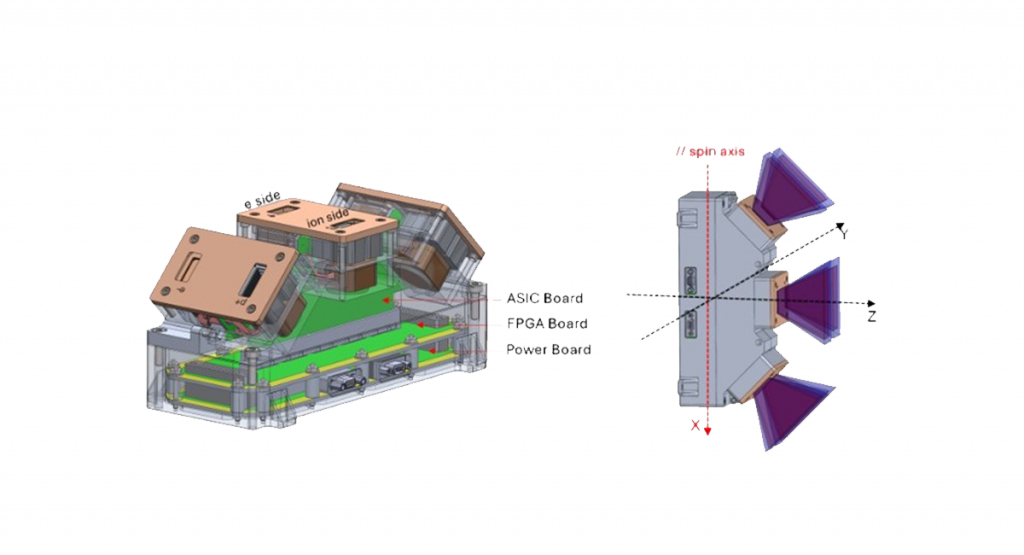
The Energetic Particle Experiment (EPE) is designed to measure the quasi-3D supra-thermal and energetic plasma velocity distribution functions (VDFs) at down to spin cadence (4s) separately for ions (protons) and electrons, simultaneously at 7 spatial positions.
The instrument consists of a compact, dual particle, three telescope array, covering 135◦ × 360◦ of the sky over a spin period, with deflecting magnets on the ion side (to screen out electrons) and screening foil on the electron side (to exclude low energy ions).
Particle energies will be resolved with sufficiently low δE/E and, over a spin period, the total sky Field of View (FoV) will be segmented into the three telescope angular sectors (along the spacecraft spin axis) and nominally 16 azimuthal bins, to construct the VDFs.
The Energetic Particle Experiment (EPE) fulfills the PO payload performance requirements reaching the following performance:
Energy Range and resolution: EPE measures supra-thermal and energetic plasma populations for both ions and electrons in the minimum energy range of 30-600 keV (with a strong goal to achieve 20-600 keV. A baseline energy resolution, ∆E/E, better than 20% for both ions and electrons (with nominally 30 channels for the baseline energy range), and greater than 12%.
Angular resolution and coverage: EPE obtains quasi-3D VDFs over a spacecraft spin period (nominally in 3 × 16 angular sectors) achieving spin resolution cadence for VDFs at in the key science regions (KSRs).
Separation and Flux Measurement: EPE will allow to cleanly separate electron and ion observations and measure the particle flux in the FoV of each detector while scanning the azimuthal direction during a spacecraft spin.
EPE is developed by a consortium led by RAL, UK with major contributions from UCLA, USA; University of Turku, Finland; CAU, Kiel, Germany, and ASRO, Finland. The main heritage of the detector assembly is from the EPD instrument on NASA’s ELFIN mission, with other heritage coming from Solar Orbiter’s EPD/EPT and STEREO SEPT instruments, and the BepiColombo SIXS instrument.