IMCA – Time-of-flight ion spectrometer
IMCA will provide measurements of the 3D distribution functions of the main ion species with an energy range covering the thermal and suprathermal energies (10 eV – 30 keV) which covers the typical ions energy range in the magnetosphere key science regions. The ion 3D distribution functions will be provided at a time resolution (2 s) enabling to resolve fluid scales for each ion species. Moreover, the 3D distribution functions will have an energy resolution (20%) and angular resolution (22.5°×22.5°) permitting to resolve non-Maxwellian features in distribution functions in all the PO’s key science regions. As a baseline, four IMCA units will fly on PO, onboard S/C 1, in the inner tetrahedron, and S/C 5, 6 and 7, in the outer tetrahedron, with the goal to populate all seven SSC.
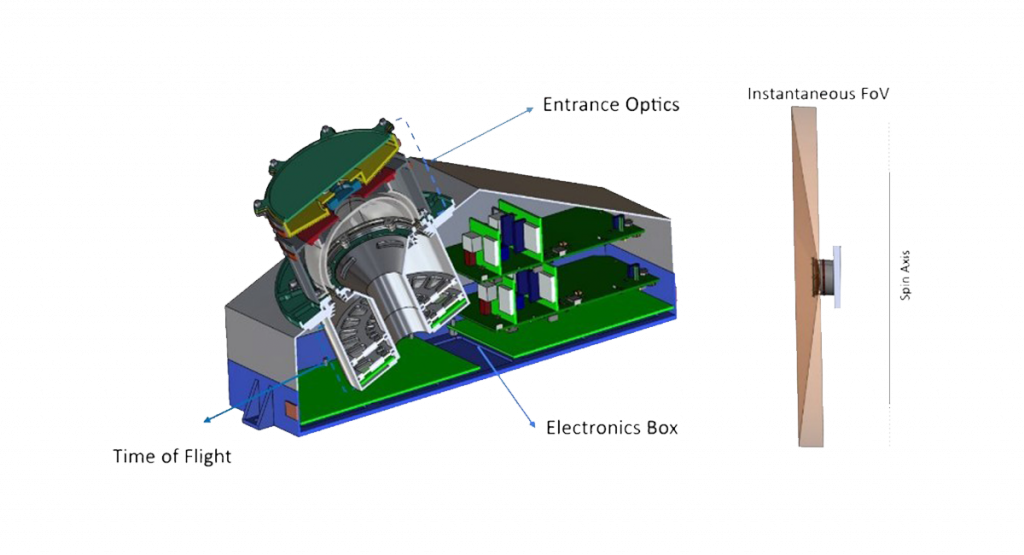
IMCA instrument is composed of three main subsystems: the entrance optics, the Time-of-Flight (ToF) assembly and the electronics box. In the entrance optics, the instrument combines energy (E) per charge (q) selection by an electrostatic analyzer (ELSA).
IMCA detection electronics combines ASIC Charge Pulse Discriminators (CPDs) integrated on the Anode Board, which perform discrimination and generate start and stop signals, together with one discrete Time-to-Amplitude-Converter (TAC) associated to an FPGA, which compute the time of flight as the difference of the start and the stop signal. The ion velocity is obtained from the time of flight and from the length of the ToF chamber. The mass per charge M/q is derived from this velocity and the E/q determined earlier by the ELSA.
The Control Unit (CU) boards assures instrument control and data processing and formatting. The energy resolution ∆E/E is 13%, while the azimuth angle resolution is about 7° and the polar resolution is the expected 22.5°. The ToF performance accomplishes the requirement in terms of mass resolution (∆M/M H+ > 8, O+ ≥ 3, He++ > 8).
IMCA is developed by a consortium led by INAF-IAPS in Italy with contributions from UNH in USA, ISAS in Japan, LPP in France, BIRA in Belgium, BME/EPSS in Hungary, and University of Bern, Switzerland.