The Plasma Astrophysics working group
The “Plasma Astrophysics” working group for Plasma Observatory has the main, ambitious goal of bridging heliospheric plasmas and far astrophysical systems by tackling the following question: How could the measurements performed by Plasma Observatory in the near-Earth environment improve our knowledge of particle energization in astrophysical systems?
Composed of a diverse and complementary group of researchers, our team includes worldwide experts in:
- Star-planet interaction and heliospheric physics;
- Galactic cosmic rays and supernova remnants;
- Large-scale cosmic-ray-driven structures (winds, halos) in the inter-stellar medium;
- Intra-cluster medium and galaxy clusters;
- Compact objects.
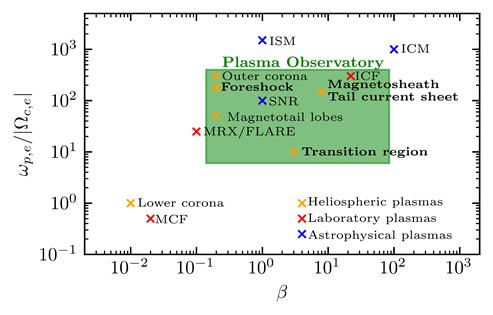
Despite important differences, these environments show similarities, in particular highlighted by adopting adimensional parameters. In this perspective, the below figure categorizes some of these environments in the β – ωp,e/Ωc,e parameter space, where β is the kinetic-to-magnetic pressure ratio, ωp,e is the electron plasma frequency, and Ωc,e is the electron cyclotron frequency. The green box highlights the region where Plasma Observatory aims at providing unprecedented multi-scale multi-point measurements.
Our work emphasizes significant points of contact between the scientific objectives of Plasma Observatory and longstanding questions regarding particle energization and transport in astrophysical plasmas including:
- How are different particle species (protons, heavy ions, and electrons) injected at shocks?
- How does the fluid- and ion-scale physics coupling determine particle energization in different contexts, including collisionless shocks, magnetic reconnection and turbulence?
- How do energetic-particle-driven instabilities and pre-existing turbulent coherent structures mediate particle transport and energization, including collisionless shocks, magnetic reconnection and turbulence?
- How is energy partitioned between different species and between thermal and non-thermal populations, including collisionless shocks, magnetic reconnection and turbulence?
List of Participants
Oreste Pezzi, Lead, ISTP/CNR, IT
Luca Comisso, Co-Lead, Columbia University, US
Aurora Simionescu, SST CP, SRON, NL
Oliver Allanson, UCL, GB
Elena Amato, INAF, IT
Lorenzo Biasotti, INAF, IT
Gianfranco Brunetti, INAF, IT
Li-Jen Chen, NASA, US
Eugene Churazov, MPA, DE
Shinsuke Imada, University of Tokyo, JP
Ahmad Lalti, Northumbria University, GB
Yuan Li, UMASS, US
Alexandre Marcowith, University of Montpellier, FR
Ileyk El Mellah, USACH, CL
Monika Moscibrodzka, Radboud University Nijmegen, NL
Sophie Musset, Johns Hopkins APL, US
Joonas Nattila, University of Helsinki, FI
Jacek Niemiec, IFJ, PL
Mitsuo Oka, UC Berkeley, US
Silvia Perri, UNICAL, IT
Christoph Pfrommer, AIP, DE
Ilya Plotnikov, MISIS, RU
Alessandro Retino’, LPP, FR
Emanuele Sobacchi, INAF, IT
Domenico Trotta, QMUL, GB
Siyao Xu, IAS, US